Bohemian Chic Icons — The Women Who Defined the Style

Bohemian chic did not arrive in 2026. It was assembled, piece by piece, over sixty years by a handful of women who dressed the way they lived — with confidence, with handcraft, with very little regard for what was fashionable that season. Their photographs still teach us how to dress. This is the long-form guide to the icons whose wardrobes anchor what Marina Anouilh sells today — the references behind the references, the women whose style choices over four decades created the bohemian chic register we now consider self-evident.
Why the icons matter
Most contemporary fashion brands trace their style references to specific runway moments — the Saint Laurent rive gauche collection of 1975, the Galliano Dior couture of the early 2000s, the Phoebe Philo Céline years. Bohemian chic is different. The references are not runway shows but personal wardrobes — the daily clothes of specific women, photographed casually, often outside any fashion context, who happened to embody a register before it had a name.
Five women in particular built the bohemian chic vocabulary over the last sixty years. Their photographs are still the most useful styling references we have. Their wardrobes are still the closest visual approximation of what we try to curate at Marina Anouilh.
Talitha Getty — Marrakech, January 1969
The photograph by Patrick Lichfield in Marrakech, January 1969 — Talitha Getty in a white kaftan, John Paul Getty Jr. seated behind her on a rooftop terrace — is the single image that most defines bohemian chic style. The kaftan is loose, the embroidery is handmade, the pose is unhurried. The light is afternoon Marrakesh. Talitha is barefoot. The image has been reproduced so many times across fashion history that it has become a visual shorthand for an entire register.
Talitha Pol Getty was the wife of John Paul Getty Jr. and a fashion muse in her own right — Yves Saint Laurent named her "the most photogenic woman in the world." Her wardrobe across the late 1960s and early 1970s combined handmade kaftans from Morocco, hand-embroidered jackets from Afghanistan, silk shifts from Italy, leather sandals from Spain. The pieces were chosen not from runways but from travels — a visible cosmopolitanism that became one of the defining marks of bohemian chic.
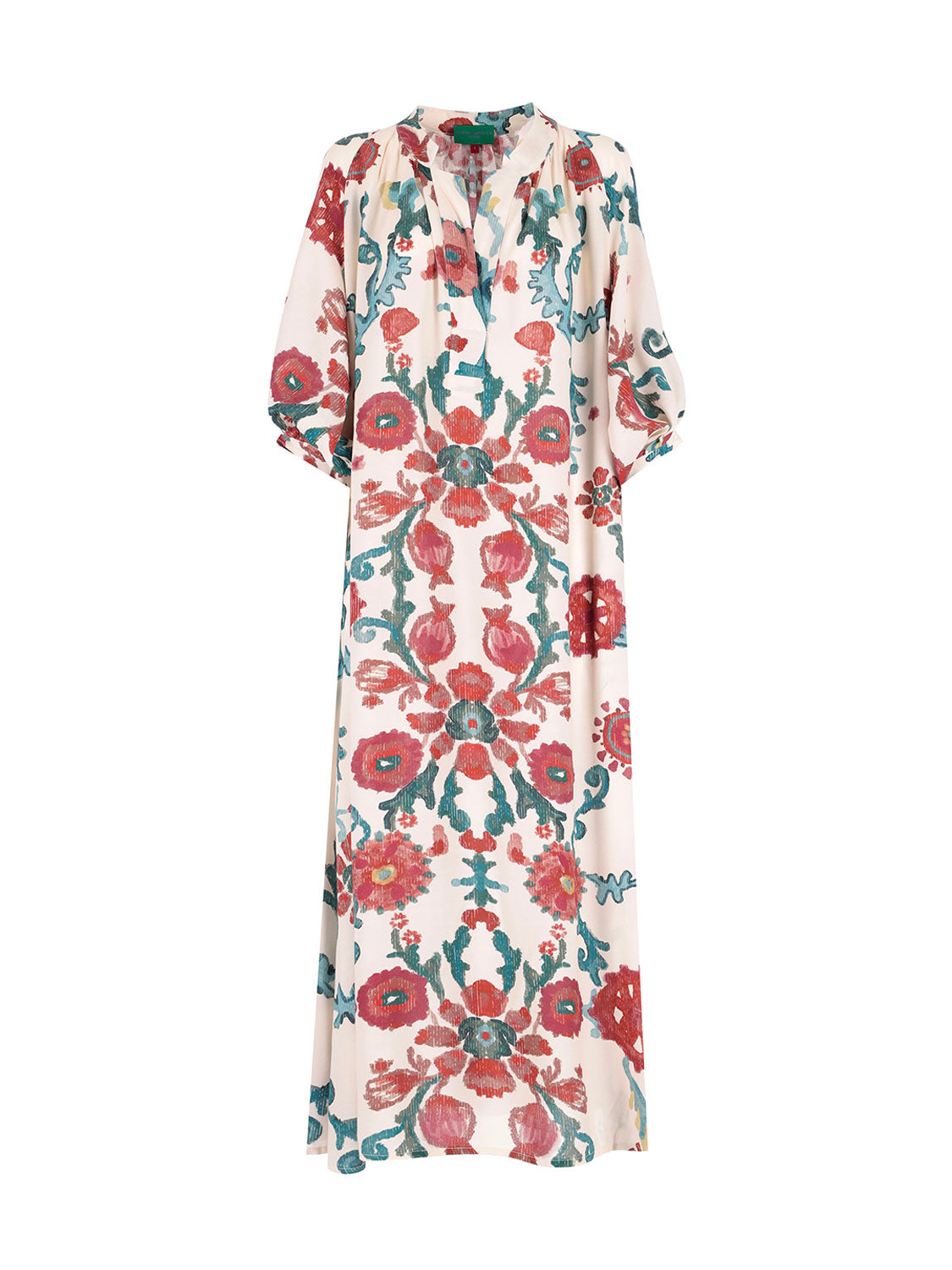
Marina Anouilh's Olympia and Laura kaftans live in direct conversation with the Lichfield image. The materials, the cuts, the relaxed proportions — each is a contemporary translation of what Talitha Getty was wearing on that rooftop in 1969. The lesson she taught the bohemian chic wardrobe: a single beautiful garment is enough.

Loulou de la Falaise — the muse of Yves Saint Laurent
Loulou de la Falaise wore bohemian chic before anyone called it that. Born to a French father and an English fashion-editor mother, she joined the Yves Saint Laurent atelier in 1972 and remained the principal accessories and jewellery designer there for over twenty years. Her personal style across the 1970s and 1980s — photographed obsessively by Helmut Newton, Guy Bourdin, Horst P. Horst — became the visual reference for what bohemian chic could look like on a working woman in Paris.
Her wardrobe combined silk shirts knotted at the waist, hand-embroidered jackets layered over plain tops, structured wool trousers (rare in bohemian iconography of the time), heavy gold-plated jewellery designed at the YSL atelier. The layering was more European than Talitha Getty's Marrakech ease — more architectural, more city-appropriate — but the material vocabulary was the same.
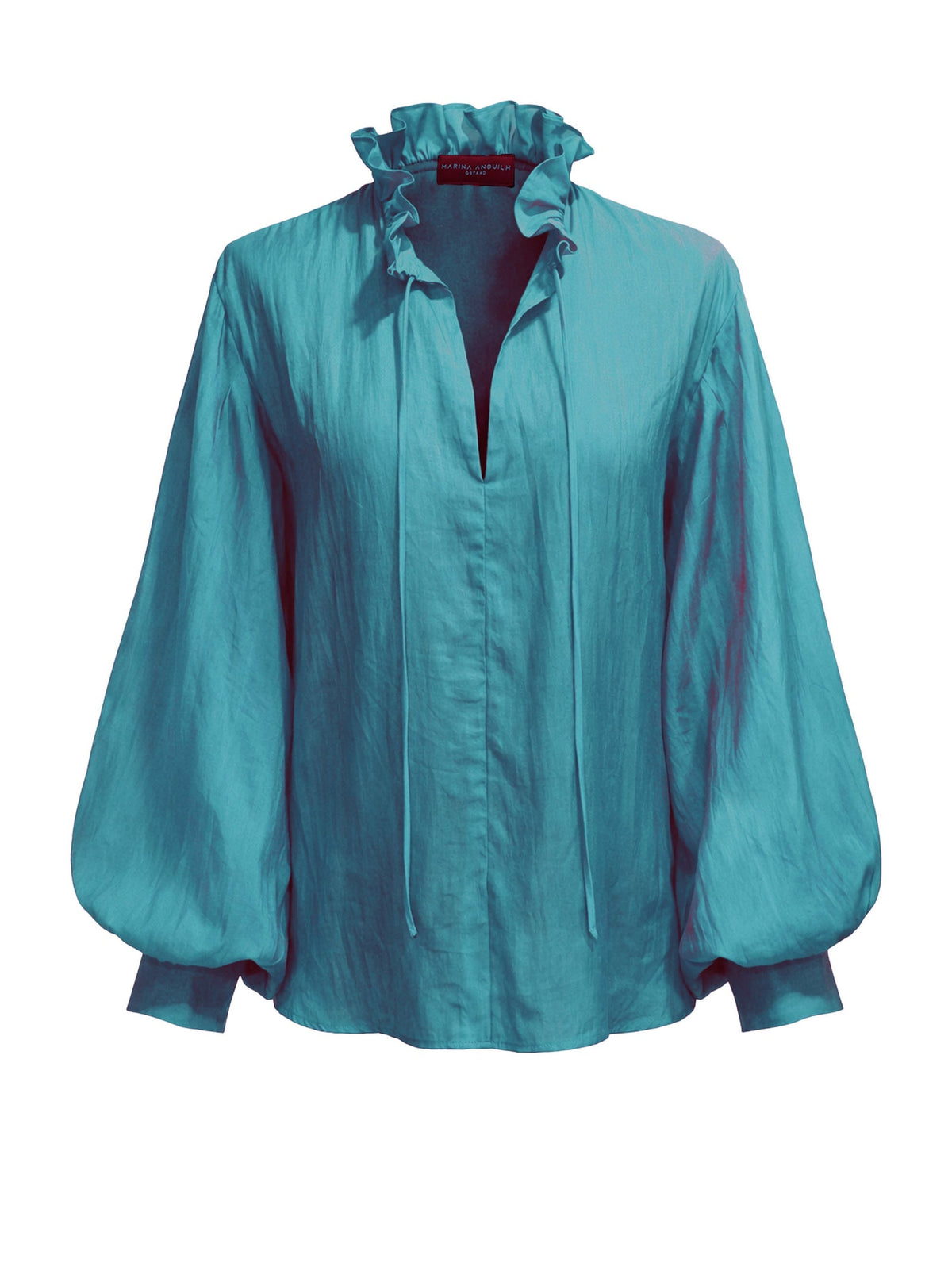
Loulou taught the bohemian chic wardrobe its tolerance for colour: silk in cherry, in cyan, in olive, often saturated and confident. The Holly silk shirts in our boutique today are her descendants — the colour palette is the one she made acceptable on a working woman who did not want to disappear into beige.
Anita Pallenberg — the bohemian chic edge
Anita Pallenberg brought the harder edge to the bohemian chic register — the boots, the fur, the silk dress worn slightly wrong, the leather belt holding everything together. Her bohemian chic was less serene than Talitha's, more rock and roll, but the materials were always handcrafted, the cuts always fluid. Photographed throughout her years with The Rolling Stones across the late 1960s and 1970s, Anita created the alternative wardrobe to Loulou de la Falaise's Parisian polish.
The Anita Pallenberg version of bohemian chic accepted asymmetry, intentional dishevelment, the slightly-too-much jewellery layered with confidence. It accepted leather (typically vintage), fur (typically antique), and the bohemian chic wardrobe extended into materials Talitha would never have touched.
The Stephanie yak coat oversized and belted, worn over an embroidered silk dress, is the Anita Pallenberg silhouette in 2026 form — the oversized outer layer that says the wearer does not care what anyone else thinks, paired with the soft silk underneath that says the wearer absolutely does care, but on her own terms.

Bianca Jagger — the bohemian chic for evening
The white suit at Studio 54 — photographed countless times in 1977 and 1978 — was bohemian chic for evening before that idea existed. Bianca Jagger's evening wardrobe across the late 1970s was architectural in cut, handmade in tailoring, restrained in jewellery. She replaced the fitted cocktail dress with the bohemian chic alternative: a column silhouette, low metallic shoes, one bright element, hair pulled back.
The Lotus silk dress is the contemporary descendant of Bianca's Studio 54 looks. A single column-cut piece, worn alone, that carries an entire evening. The Olivia Dar sequin pouch substitutes for the gold-plated YSL jewellery she favoured. The low metallic sandals substitute for the heeled satin shoes. The principle is identical: one decisive piece, the rest stays quiet.
Charlotte Rampling — the bohemian chic into older age
Charlotte Rampling has aged into bohemian chic with a precision few have matched. Her photographs at 60, 70, 75 — in linen, in cashmere, in silk — are how to dress this register at every age. She taught the wardrobe its longevity: pieces bought at 35 still work at 75. That is the bohemian chic promise made visible across decades.
The Charlotte Rampling version is the most disciplined of all. The colour palette narrowed to cream, taupe, navy, olive. The silhouettes simplified to columns, A-lines, and structured outer layers. The jewellery reduced to one delicate ring stack or one architectural earring. Hair short, sometimes grey, always uncomplicated. This is bohemian chic at its most editorial — the version we point younger clients to when they ask what their wardrobe could look like at sixty.
Marisa Berenson — the bohemian chic in repose
Marisa Berenson's Vogue editorials of the 1970s — photographed by Penn, Avedon, Newton — captured bohemian chic in repose. The kaftan on a terrace. The silk shirt at a lunch table. The yak coat across the back of a chair. She taught the wardrobe its quietness.
Berenson's photographs are remarkable for what they do not include: drama, posing, statement accessories. The clothes do all the work. The wearer is doing nothing in particular — sitting, reading, smoking, talking. The photographs work because the wardrobe is interesting enough to hold the eye without help from the body. This is the photographic test of any bohemian chic outfit: does it hold up when you are not trying?
What they share
None of these women were chasing trends. They wore what fit them, made by people they knew, in materials they understood. They wore the same pieces for years. They did not photograph themselves — they were photographed by others, almost incidentally, going about their lives. The photographs survived because the wardrobes were worth surviving.
Five shared principles emerge from looking across their wardrobes:
- Materials over silhouettes. Each woman chose materials first — silk, linen, handcraft — and let the silhouettes follow.
- One signature piece per outfit. The kaftan, the silk shirt, the column dress, the oversized coat — each outfit had one piece doing the storytelling.
- Accessories as tools. Bags that opened. Belts that held. Shoes that walked. Jewellery that caught light but did not perform.
- Restraint in colour. Earth tones as anchors, jewel tones in silk only, one bright element per outfit.
- The wardrobe held value across decades. Pieces bought in 1968 still appeared in photographs of 1985. The wardrobe was an investment in personal continuity.
The contemporary equivalents at Marina Anouilh
If you want to dress like Talitha Getty in 2026, the Olympia Kaftan Dress or the Laura cream Suzani kaftan is the closest contemporary translation. Worn with a wide Moroccan leather belt and bare feet on a rooftop terrace, the image essentially reproduces itself.
If you want to dress like Loulou de la Falaise: the Holly silk shirt in cherry knotted at the waist over wool wide-leg trousers, with a structured leather satchel and gold-tone architectural earrings. The Parisian working version of bohemian chic.
If you want to dress like Anita Pallenberg: the Stephanie Yak Long Coat oversized, belted, over a silk dress, with leather boots and intentionally-tousled hair. The harder-edged version of the register.
If you want to dress like Bianca Jagger: the Lotus silk dress in ivory or plum, with low metallic sandals and the Olivia Dar pouch. The evening column.
If you want to dress like Charlotte Rampling: any single piece in the Marina Anouilh boutique, worn alone, with minimal accessories, in a single colour story. The most disciplined version.
The icons we do not name
Beyond the five most-photographed icons, dozens of women across four decades quietly built the register without becoming photographic celebrities. The Greek women dressing for summer on Hydra in the 1970s. The Swiss women dressing for alpine ski seasons in the 1980s. The Italian women dressing for Capri in the 1990s. The French women dressing for Provence in the 2000s. Each contributed pieces, combinations, ideas that flowed through magazine editorials and word-of-mouth styling into what is now an established register.
This is also the lesson of bohemian chic: you do not need to be famous to be photographable. The wardrobe is built for the woman who looks the way the icons looked when they were not posing — unhurried, considered, slightly out of focus, entirely herself.
FAQ
Are there contemporary icons of bohemian chic?
The contemporary register is less centred on individual icons and more diffused across women who do not seek photographic attention. Margot Robbie in her Saint Laurent moments. Sienna Miller across the 2010s and 2020s. Tilda Swinton in her sculptural Loewe moments. But none of these dominate the visual field the way the original icons did — partly because the fashion press is more fragmented now.
How do I find photographic references for my own wardrobe?
Save the Patrick Lichfield Marrakech photographs of Talitha Getty (Wikimedia Commons has several). Save the Helmut Newton portraits of Loulou de la Falaise. Save the Avedon and Penn editorials of Marisa Berenson. Build a personal mood board of the five women's photographs and refer to it when shopping or building outfits.
Are the men's equivalents documented somewhere?
The male equivalent register has its own icons — Yves Saint Laurent himself, Rudolf Nureyev, Jean-Paul Goude, Karl Lagerfeld in his early years. But the male bohemian chic register is smaller and more uniform. The women's wardrobe is the richer historical archive.
What do these icons have in common beyond style?
Confidence, multilingualism, cosmopolitanism, financial independence, an unusual relationship to fame. None pursued fashion as a career except Loulou; all became fashion icons by accident of being themselves. The clothes followed from the lives, not the other way around.
Closing
That is bohemian chic, in the end — not a style adopted, but a way of dressing that emerges from a particular kind of attention to the world. Marina Anouilh's boutique exists to make that attention available again, to a new generation of women who recognise themselves in the Lichfield rooftop photograph from 1969 and want to build something similar in 2026.
Explore the Bohemian Chic collection, read the complete style guide, or book a personal styling appointment to build your own contemporary translation of these wardrobes.
Continue reading — the bohemian chic edit
If this guide is useful, the rest of the cluster goes deeper on related questions: how Marina wears the style, the craft behind it, the fabric glossary, and the seasonal edits.
- complete bohemian chic guide
- quiet boho 2026
- the craft behind bohemian chic
- the colour palette
- how Marina wears bohemian chic
You can also browse the full bohemian chic collection, or book an in-store appointment at our Gstaad or St Moritz boutiques to be styled in person.