The Craft Behind Bohemian Chic — Embroidery, Sabra, Yak, Raffia

Strip away the silhouettes, the colours, the styling rules — and what remains of bohemian chic is craft. The Marrakesh atelier where each jacket is hand-embroidered. The Mongolian herders who comb yak undercoat each spring without shearing. The women's cooperatives in Madagascar that weave raffia into the Tiana bags. The embroiderers in Central Asia who hand-stitch Suzani panels in patterns their grandmothers stitched. Every piece in the boutique passes through named places and named hands. This is the story of those hands, the materials they work with, and why the craft makes the difference between a generic bohemian look and the Marina Anouilh register.
Why craft matters in bohemian chic
Bohemian chic in 2010 was largely a print story — paisleys, florals, ethnic motifs printed onto fast-fashion fabrics. The look was achievable from any high-street retailer. By 2026 the register has shifted decisively away from print and toward texture and provenance. The difference between a piece that reads as bohemian chic and a piece that reads as costume is now overwhelmingly about how it was made, where it was made, and who made it.
At Marina Anouilh, every piece carries its provenance visibly. The slight irregularities of hand-embroidery. The natural colour variation of plant-dyed sabra. The handmade weave of Madagascar raffia. These are not flaws — they are the visible signature of craft. The same garment made by machine would lose what makes it bohemian chic.
Sabra — Marrakesh, Morocco
Sabra is sometimes called "Moroccan silk" or "cactus silk", but it is neither silk nor strictly cactus. The fibre comes from the leaves of the agave plant. Around Marrakesh and across the Atlas Mountains, the leaves are harvested, crushed to release the long fibres, dried in the sun, hand-spun, dyed with natural pigments (saffron, indigo, henna, pomegranate, walnut), and woven on traditional looms in family workshops.
The result is a fabric with the lustre of silk, the strength of cotton, and the slightly irregular texture that only hand-weaving produces. Sabra dyes brilliantly because the natural fibre takes pigment in a way no synthetic can imitate — each colour carries depth and slight variation across the bolt.
In the Marina Anouilh boutique, sabra appears as the trim along the front placket, collar, and hem of every Marrakesh jacket. It also appears in scarves, the Moroccan belts, and occasional small accessories. Each metre of sabra takes approximately one day of weaving. The trim on a single Marrakesh jacket represents roughly half a day's work from a single weaver.
The atelier we work with outside Marrakesh has been weaving sabra for three generations. The current weavers learned from their mothers, who learned from theirs. The patterns and dye recipes are passed by demonstration and memory, not by written record.

Yak — Mongolia
Yak is the bohemian chic mountain material. The undercoat of the Mongolian yak — the soft, downy fibre closest to the skin, distinct from the coarser outer hair — is shed naturally every spring as the animal sheds its winter coat. Nomadic herders comb the animals (no shearing, no harm to the yak), and the gathered undercoat is spun into yarn.
The fibre is extraordinary by every technical measure. It is warmer than cashmere of equivalent weight, lighter than wool, naturally water-resistant (yaks live in environments down to minus 40°C), naturally odour-resistant (because of its molecular structure), and entirely sustainable (because no shearing is involved and the herders' livelihood depends on the health of the animals).
The Stephanie Yak Long Coat is woven from 100% Mongolian yak undercoat. No blends. The weight is approximately 450 grams per square metre — substantial but light against the skin. The colour comes from the natural shading of the yak undercoat itself (taupe is undyed; navy is dyed with natural pigments).
Marina sources directly from a Mongolian cooperative that works with about fifteen nomadic herder families across the central steppe. The annual production from this cooperative is limited — perhaps 500 coats per year across all brands they supply — which is why the Stephanie has always been a small-batch piece in our boutique.

Habotai silk — China, Japan
Habotai (sometimes "China silk" or "pongee") is the lightest, smoothest silk in the bohemian chic vocabulary. Originally woven in Japan (the name means "feather-light" in Japanese), now produced across East Asia, habotai is the silk that drapes most beautifully against skin.
The fibre comes from the cocoon of the silkworm, harvested after the moth has emerged (a slower, more ethical process than the conventional silk industry, which kills the silkworm to preserve the cocoon's continuous filament). The fibre is then spun, dyed, and woven on traditional looms. Habotai has a slight irregularity in the weave that gives it the distinctive matte-meets-lustre texture.
Habotai is what makes the Holly silk shirts, the Perrine dresses, the Lotus column, and the Britania tiedye feel the way they do — like wearing nothing, but the right kind of nothing. Habotai dyes brilliantly (which is why the cherry, cyan, and olive colourways are as saturated as they are) and washes well at low temperatures by hand.

Suzani — Uzbekistan, Tajikistan, Iran
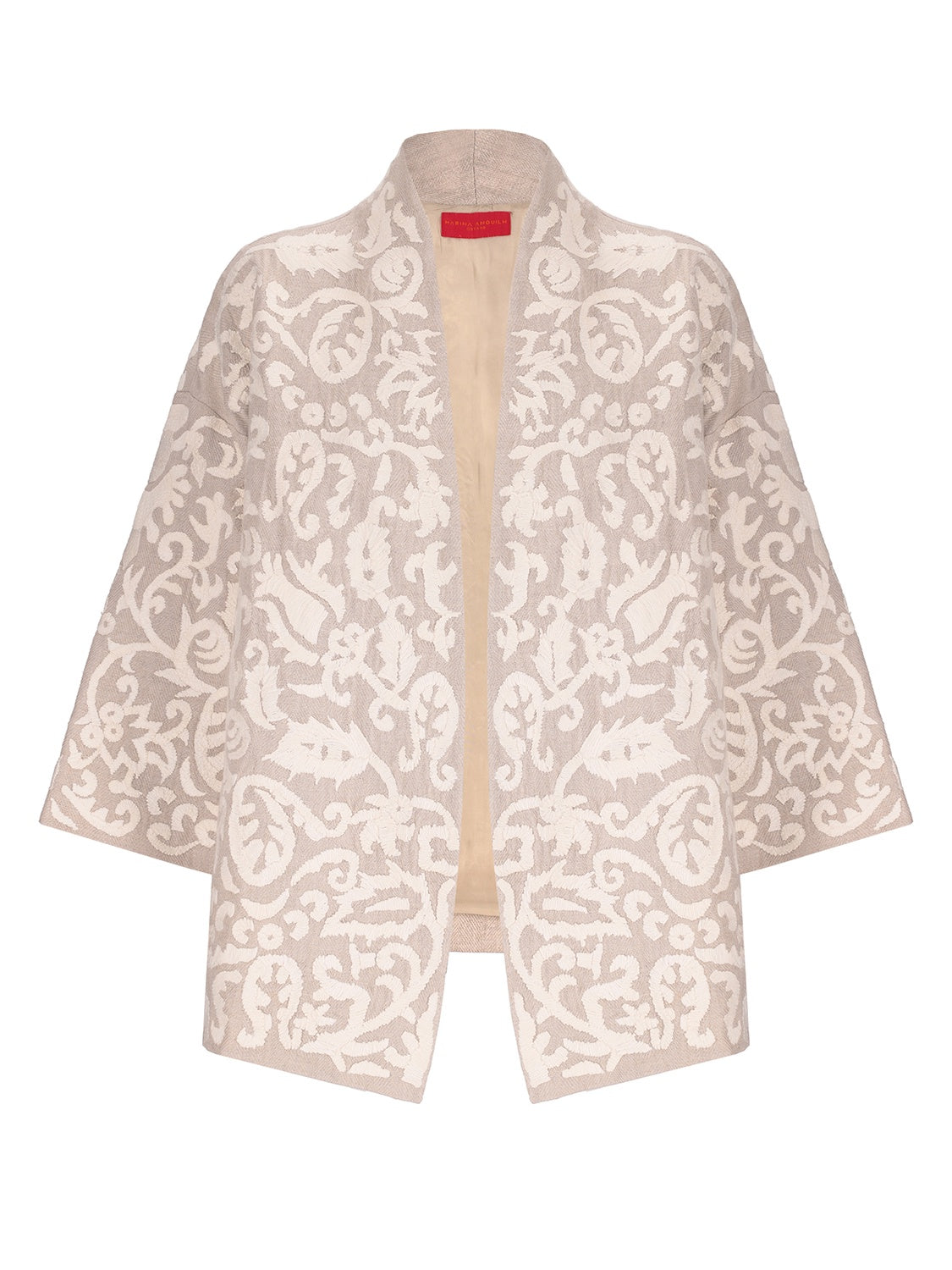
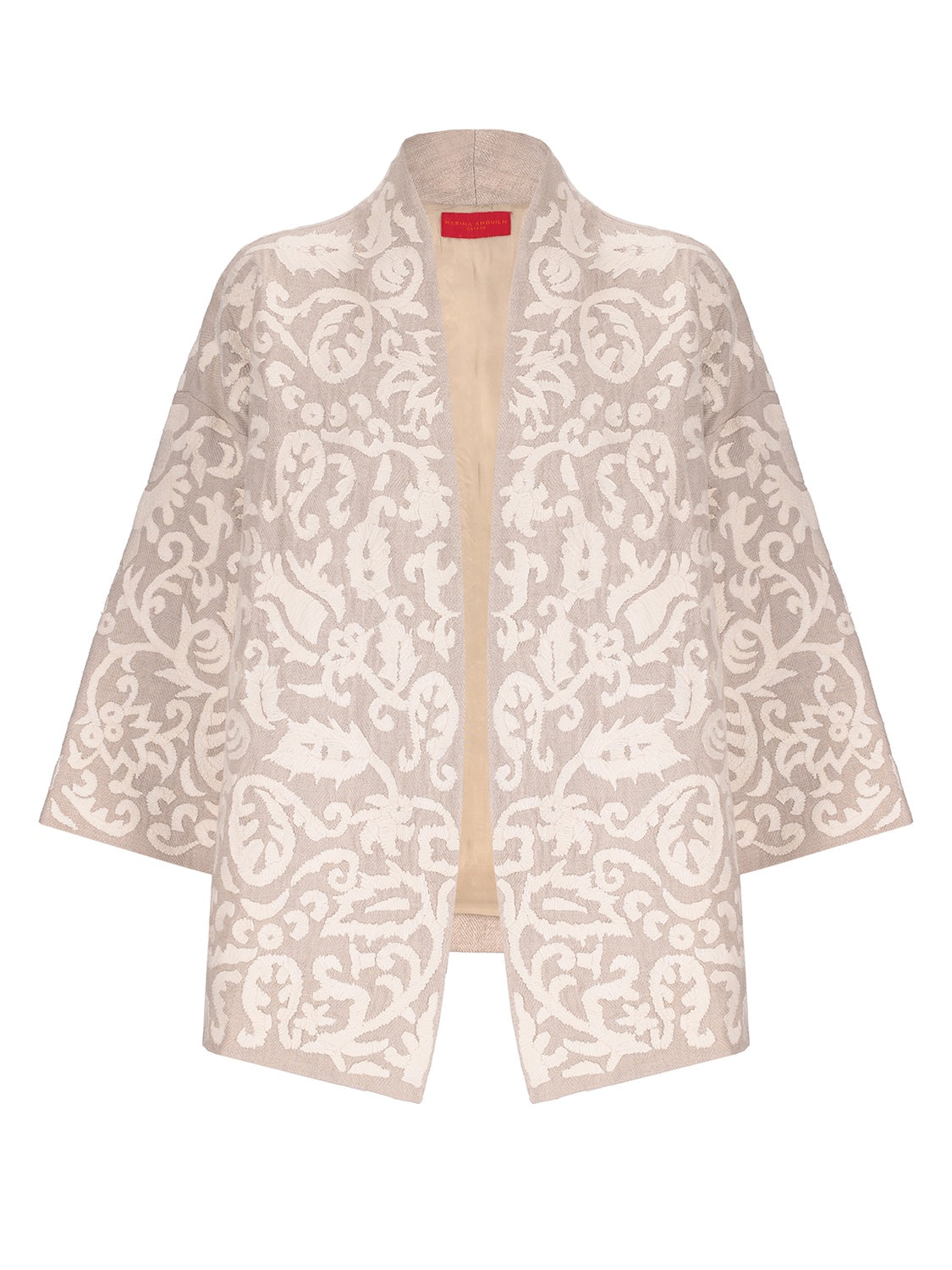
Suzani is not a fabric but a tradition. Suzani embroidery, from the Persian word for needle (suzan), comes from the silk-route cities of Central Asia — Bukhara, Samarkand, Tashkent, Tabriz. The tradition is centuries old: traditionally, young brides embroidered Suzani panels as part of their dowry, and the patterns carried symbolic meaning (pomegranate for fertility, sun for protection, vine for prosperity).
Suzani is hand-embroidered on cotton or linen ground fabric with silk thread, using a combination of chain stitch, satin stitch, and couching stitch. The patterns are large — a single Suzani panel might contain hundreds of motifs across two metres of ground fabric — and take weeks to months to complete.
At Marina Anouilh, the Suzani tradition appears in the Gaia New Suzani Embroidered jacket and the Laura Kaftan Cream Indira. Both pieces are embroidered by hand in Central Asia, then constructed in our atelier partners. Each piece is unique — the embroidery pattern is consistent within a design, but the colour interpretation and stitch density vary slightly between pieces.
Linen — France, Belgium, Italy
The bohemian chic linen we source is European — flax grown in Normandy and northern France, spun in Belgium and Italy, woven in family mills. France is the world's largest producer of flax (about 80% of global flax for textiles comes from France, Belgium, and the Netherlands), and the resulting linen is among the highest-quality textile fibres available.
Linen has properties no synthetic can replicate. It is naturally antibacterial, naturally cooling in heat, naturally insulating in cold. It softens with each wash. It wrinkles — which is half the point. Wrinkles are how linen tells time. A linen jacket worn for ten summers has the kind of patina no new fabric carries.
The Gaia linen coral embroidered jacket, the Olympia Fuji Kaftan in cotton-linen, and the Geisha Hemp Jacket all carry European linen at their core.
Raffia — Madagascar
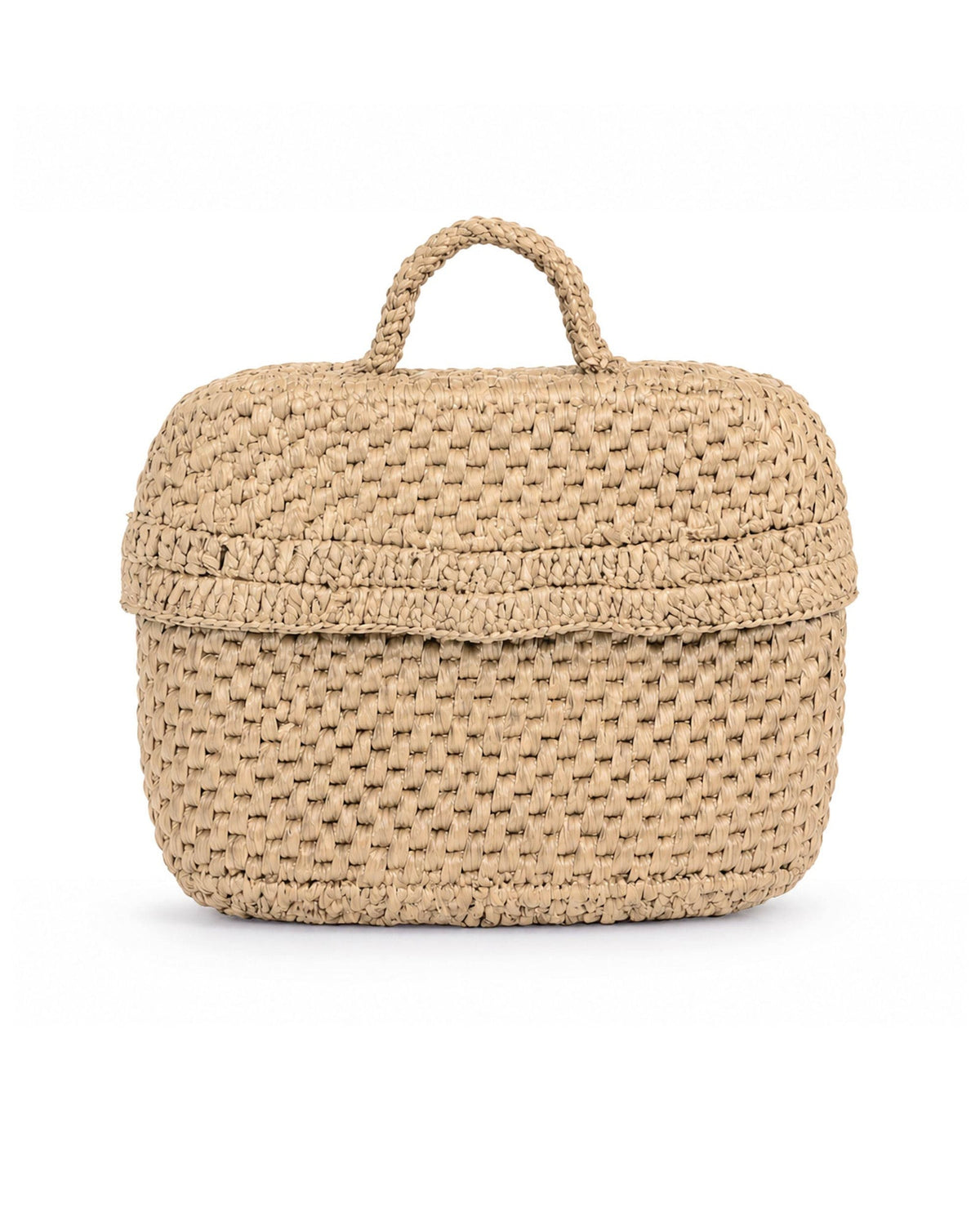
Raffia is the bohemian chic summer material par excellence. Hand-harvested from the leaves of the raffia palm (Raphia farinifera) in Madagascar, the fibre is dried in the sun, split into long strands, twisted by hand, and woven into bags, hats, and accessories by women's cooperatives.
The Tiana raffia bags are produced by a cooperative of approximately forty women in central Madagascar. Each bag takes three to five days from harvest to finished piece. The strap, the body, the handles, the closure — every element is hand-woven. The fibre is fully biodegradable; the work supports an entire community.
The colour palette of the Tiana bags — almond, chestnut, natural — is achieved through natural dyeing (almond from walnut shells, chestnut from oak gall, natural from undyed fibre). The colours deepen with time and use.

Mughal-technique ballet flats — India
The Marrakesh Ballet Flats by Meher Kakalia are made in India using Mughal embroidery techniques that date to the 16th and 17th centuries. Each pair is hand-embroidered by women artisans, with leather soles attached by hand. The patterns are inspired by traditional Mughal court textiles.
Meher Kakalia, the designer behind the collection, works with a network of women's ateliers in Uttar Pradesh and Rajasthan. The atelier model is rare in contemporary footwear — most ballet flats today are entirely machine-made — which is why each Meher Kakalia pair is slightly different and ages into something more interesting than a commodity flat.
Sequin embroidery — India (Olivia Dar)
The Olivia Dar sequin pouches are hand-embroidered in India, sequin by sequin, on natural cotton ground. Olivia Dar is the Parisian designer behind the collection; her network of embroiderers in Mumbai and Kolkata produce small-batch pieces in colour stories she selects each season.
A single XL pouch carries between 8,000 and 12,000 sequins, applied by hand over approximately a week. The labour-intensive process is what makes each piece read as evening jewellery rather than a conventional clutch.
Knot raffia — London (Babette)
The Babette ribbon knit mini bag in green belongs to a different craft register — hand-knitted in London by Lorenza Gandaglia’s small atelier. Cotton ribbon, fully lined, with a slim leather shoulder strap. Each piece takes about a day of knitting plus finishing. The colour palette is unexpectedly bright — green, fuchsia, rust — and the bag pairs particularly well with quieter clothing as a single bright note.
The economics of craft
A natural question: why do these pieces cost what they cost? The short answer is that the materials are real and the labour is fairly compensated. A Marrakesh jacket carries roughly four to five days of human work between weaving the sabra trim, embroidering the panels, sewing the construction, and finishing by hand. A Tiana raffia bag carries three to five days of weaving. A Stephanie yak coat carries weeks of work from herder to weaver to construction atelier.
When you compare to fast-fashion equivalents (a synthetic "raffia-look" bag at €35, an embroidered "Moroccan-style" jacket at €120), the difference is that the artisans in our supply chain are paid living wages, the materials are real and traceable, and the pieces last decades rather than seasons. The cost per wear over a decade is typically lower than the fast-fashion alternative.
How to recognise craft when you see it
- Look at the back of the embroidery. Hand-embroidered pieces show stitch irregularities. Machine embroidery is uniformly perfect.
- Feel the fabric. Sabra has a slightly irregular texture. Habotai silk has a matte-lustre that polyester cannot replicate. Yak feels light but warm in a way wool blends do not.
- Look at the colour. Naturally dyed fabrics have depth and slight variation. Synthetic dyes are flat and uniform.
- Examine the seams. Hand-stitched seams have slight irregularities and double-stitching for strength. Machine seams are perfectly uniform but often single-stitched.
- Ask the provenance. A boutique that cannot tell you where a piece was made by whom is selling something other than craft.
FAQ
Is all bohemian chic clothing made by craft?
Not by definition. Most fast-fashion "boho" is machine-made imitation. What distinguishes bohemian chic in the contemporary luxury sense is the visible mark of human craft.
How do I care for these handmade pieces?
Generally: hand-wash silks, brush yak coats, keep raffia dry, dry-clean Marrakesh jackets once per year only. Each piece carries care instructions — follow them and the pieces last decades.
What if a piece shows a flaw?
If the irregularity is part of the craft (slight embroidery variation, natural colour variation), that is value, not flaw. If it is genuine construction defect (broken seam, missing stitch), contact us — we replace or repair.
Where can I see the craft up close?
Visit any of our boutiques and ask to inspect a piece. We are happy to point out the visible signs of hand-work — the embroidery back, the sabra weave, the yak weight, the raffia twist. The pieces speak when you know what to look for.
Closing
Bohemian chic at Marina Anouilh is, in the end, a way of saying: the world still has hands that make beautiful objects, and we are committed to keeping those hands employed. Every piece in the boutique is a small choice in that direction. When you wear a Marrakesh jacket, a yak coat, a Tiana raffia bag, you are wearing the work of a named atelier in a named place. That visible connection is the whole point of the register.
Read our complete materials glossary, browse the Bohemian Chic collection, or book a personal appointment to see the craft pieces up close.
Continue reading — the bohemian chic edit
If this guide is useful, the rest of the cluster goes deeper on related questions: how Marina wears the style, the craft behind it, the fabric glossary, and the seasonal edits.
You can also browse the full bohemian chic collection, or book an in-store appointment at our Gstaad or St Moritz boutiques to be styled in person.