Bohemian Chic Glossary — Sabra, Yak, Habotai, Suzani

Bohemian chic is, at its core, a vocabulary of materials. The look is built less by silhouette than by what each garment is made of, and where it was made. This complete glossary decodes the seven materials that define the Marina Anouilh boutique: sabra from Morocco, yak from Mongolia, habotai silk from East Asia, Suzani embroidery from Central Asia, linen from Europe, raffia from Madagascar, and the supporting characters (cotton, wool, hemp, leather). For each material: the origin, the production, how to recognise it, how to wear it, and how to care for it.
Why materials matter more in bohemian chic than elsewhere
In most contemporary fashion registers, materials are interchangeable. A polyester blend can stand in for silk. A printed cotton can stand in for hand-embroidery. The visual outcome is approximately the same; the cost of production is much lower. Bohemian chic refuses this substitution. The whole emotional register of the style depends on the materials being real — the slight irregularities of hand-weaving, the unique drape of natural silk, the visible mark of craft. A bohemian chic wardrobe in synthetic fabrics is a contradiction in terms. The materials are not the costume; they are the substance.
This glossary is for clients who want to know what they are buying when they buy a Marina Anouilh piece. It is also a guide for spotting craft when you see it elsewhere, and for explaining to a friend why a hand-woven raffia bag from Madagascar costs more than a synthetic look-alike from a department store.
Sabra silk — Morocco
Sabra is sometimes called "Moroccan silk" or "cactus silk", but it is neither silk nor, strictly speaking, exclusively cactus. The fibre is extracted from the leaves of the agave plant, spun by hand, dyed with natural pigments, and woven on traditional looms in the Atlas Mountains and around Marrakesh. The resulting fabric has the lustre of silk, the strength of cotton, and the slightly irregular texture that handmade weaving leaves behind.
In our boutique, sabra appears as trim on the Marrakesh Herringbone jacket family, as accents on hand-embroidered pieces, and occasionally as small scarves and belts. Each metre takes a day of weaving on a traditional loom. No two pieces are identical, and that is the point. The dyeing process uses natural pigments — saffron, indigo, henna, pomegranate skin, walnut shell — which produces colours with depth and slight variation that no synthetic dye can replicate.
How to recognise sabra: slight irregularities in the weave, a matte-meets-lustre surface, colours with depth (look closely — a sabra colour has multiple tones within a single shade), a slightly textured handfeel different from silk or cotton.
How to care for sabra: dry-clean only, avoid water, store away from direct sunlight, do not iron directly on the fibre.

Yak wool — Mongolia
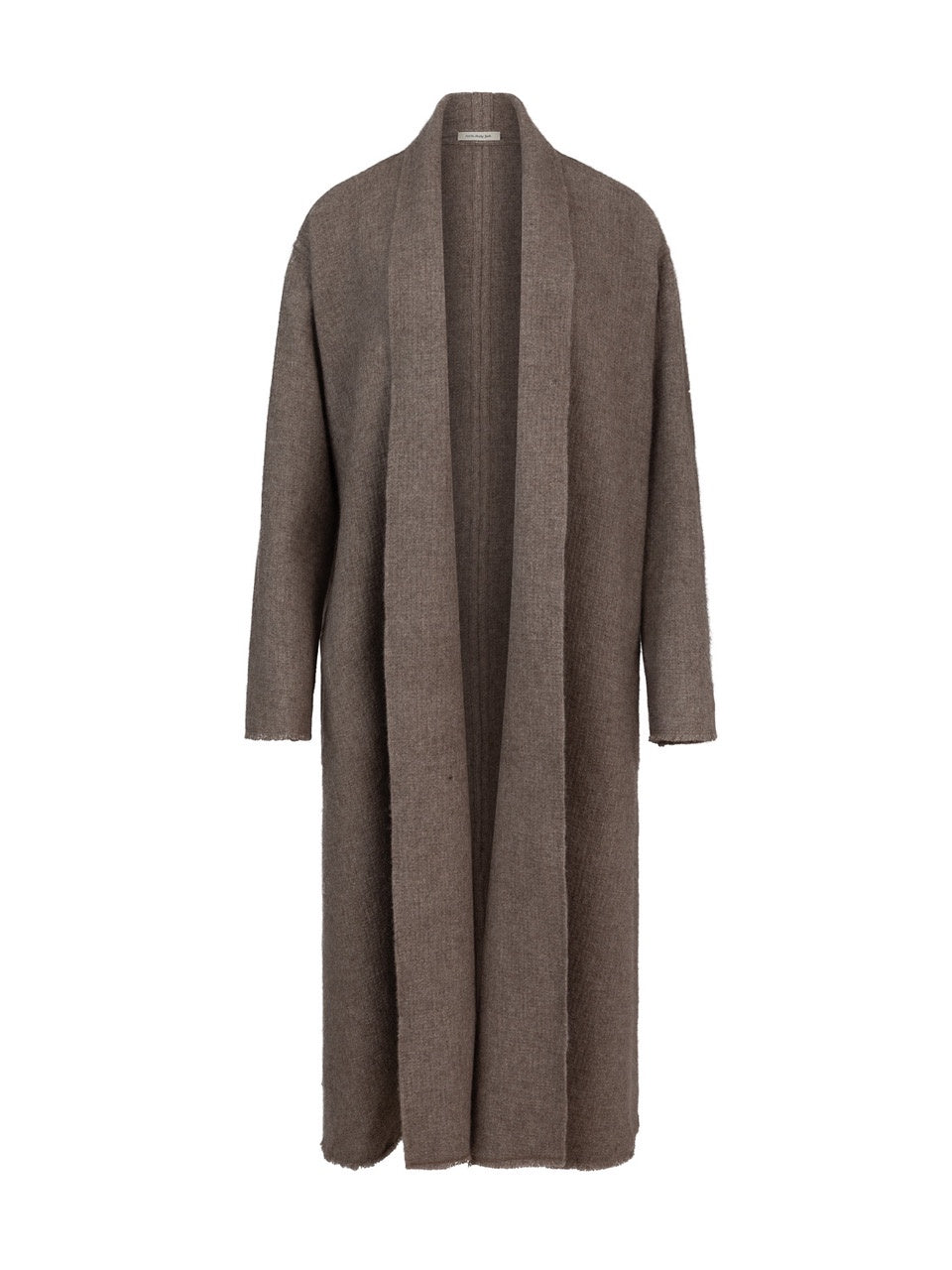
Yak is the bohemian chic mountain material. The undercoat of the Mongolian yak — the soft, downy fibre closest to the skin — is shed naturally every spring as the animal sheds its winter coat. Nomadic herders comb the animals (no shearing required, the practice is sustainable), spin the fibre into yarn, and the result is one of the warmest, lightest, and most sustainable wools on earth.
The Stephanie Yak Long Coat is woven from this fibre — 100% yak, no blends. Yak is naturally water-resistant (yaks evolved in environments down to minus 40°C), naturally odour-resistant (a molecular structure that resists bacterial growth), and naturally temperature-regulating (warm without overheating, cool when the wearer is). It is the bohemian chic answer to cashmere — softer, slower, more ethical alternative.
How to recognise yak: the fibre is slightly coarser than cashmere but extraordinarily warm for its weight. The natural colours range from cream through taupe to dark brown. The weave has a slight texture distinguishable from merino wool.
How to care for yak: brush with a soft natural-bristle brush after wear. Dry-clean annually. Store on a wide hanger or folded flat with cedar to deter moths. Avoid water (yak is water-resistant but not waterproof). With proper care, yak coats last fifteen to twenty years.
Habotai silk — China, Japan
Habotai (sometimes "China silk" or "pongee") is the lightest, smoothest silk in the bohemian chic vocabulary. Originally woven in Japan (the name means "feather-light"), now produced across East Asia, habotai is the silk that drapes most beautifully against skin. It is what makes the Holly shirts, the Perrine dresses, the Lotus column, and the Britania tiedye feel the way they do — like wearing nothing, but the right kind of nothing.
Habotai dyes brilliantly (which is why the cherry, cyan, and olive colourways are as saturated as they are) and washes well at low temperatures by hand. The fibre comes from the cocoon of the silkworm, harvested either before or after the moth emerges (the latter is the more ethical process). Habotai has a slight irregularity in the weave — distinguishing it from the more uniform satin weave — that gives it the distinctive matte-meets-lustre texture.
How to recognise habotai: lightweight, fluid drape, slight matte texture with subtle sheen, cool against skin, dyes in saturated colours without losing depth. Polyester silk-alternatives feel slippery and warm against skin; real habotai feels cool and slightly textured.
How to care for habotai: hand-wash in cold water with mild soap, hang to dry away from direct sunlight, iron on low heat with a cloth between iron and silk if needed. Most habotai pieces wrinkle little when rolled rather than folded.

Suzani embroidery — Uzbekistan, Tajikistan, Iran
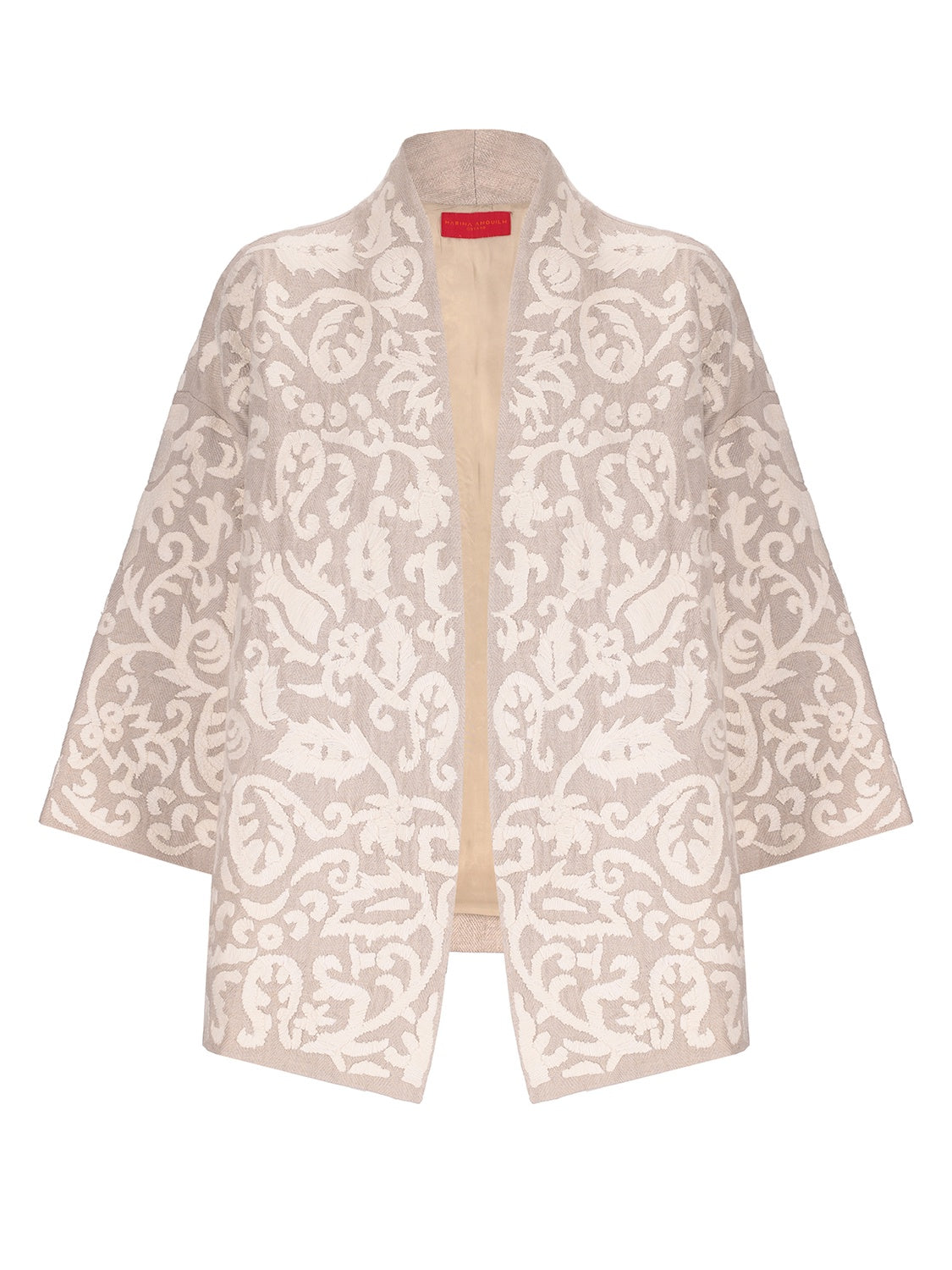
Suzani is not a fabric but a tradition. Suzani embroidery, from the Persian word for needle (suzan), comes from the silk-route cities of Central Asia — Bukhara, Samarkand, Tashkent, Tabriz. The tradition is centuries old: traditionally, young brides embroidered Suzani panels as part of their dowry, and the patterns carried symbolic meaning (pomegranate for fertility, sun for protection, vine for prosperity, tulip for spring renewal).
Suzani is hand-embroidered on cotton or linen ground fabric with silk thread, using a combination of chain stitch, satin stitch, and couching stitch. The patterns are typically large, organic, and symmetric — a single Suzani panel might contain hundreds of motifs across two metres of ground fabric — and take weeks to months to complete.
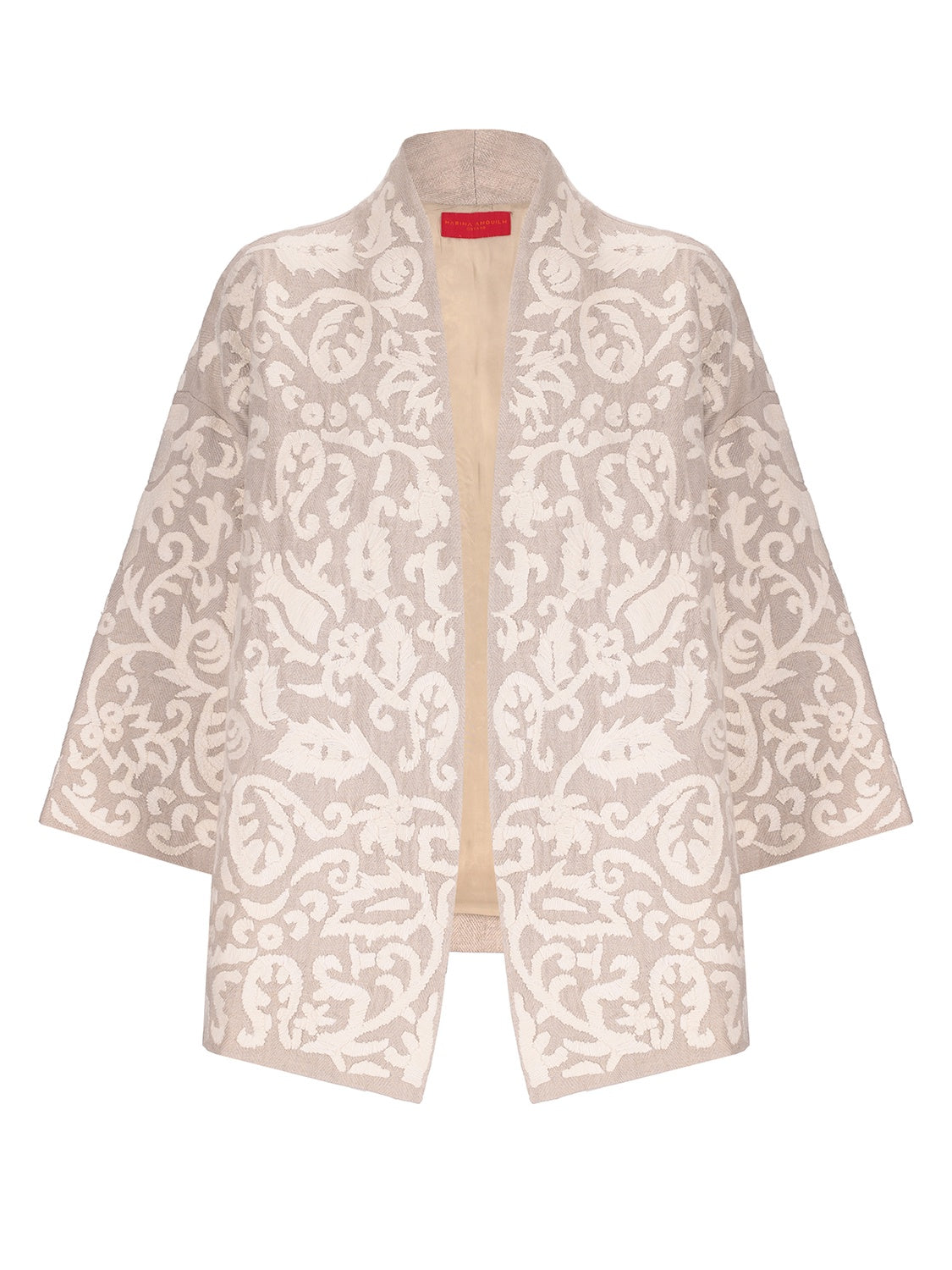
The Gaia New Suzani Embroidered jacket and the Laura Kaftan Cream Indira (Suzani-inspired) carry this tradition into the contemporary bohemian chic wardrobe — each piece takes weeks to embroider, and the variations between pieces are the work of individual hands.
How to recognise Suzani: organic symmetric patterns (often pomegranate, sun, vine motifs), large-scale embroidery on cotton or linen ground, raised stitchwork visible from both sides, slight irregularities in pattern execution that prove human work.
How to care for Suzani: dry-clean only, store flat or on a wide hanger, avoid sunlight which fades natural dyes. Spot-clean stains immediately with a damp cloth.
Linen — France, Belgium, Italy
The bohemian chic linen Marina Anouilh sources is European — flax grown in Normandy and northern France (which produces approximately 80% of the world's textile-grade flax), spun and woven in Belgium and Italy. Linen is the bohemian chic warm-weather material. It wrinkles, which is half the point — wrinkles are how linen tells time. The Gaia linen jacket, the Olympia Fuji Kaftan, the Geisha Hemp Jacket all carry European linen at their core.
Linen has properties no synthetic can replicate. Naturally antibacterial. Naturally cooling in heat (it conducts heat away from the body). Naturally insulating in cold (the fibre traps air in its hollow structure). Softens with every wash. The fibre actually grows stronger when wet — which is why linen sheets have lasted centuries in family homes.
How to recognise linen: visible weave texture, slubby surface, distinct cool handfeel, wrinkles within an hour of wearing. Polyester linen-alternatives feel smoother, do not wrinkle, do not cool the skin.
How to care for linen: machine-wash on cool, hang to dry, iron only if you dislike wrinkles (most bohemian chic wearers do not). Linen softens with every wash; do not be alarmed if it feels stiff when new.

Raffia — Madagascar
Raffia is the bohemian chic summer material par excellence. Hand-harvested from the leaves of the raffia palm (Raphia farinifera) in Madagascar, the fibre is dried, twisted, and woven into the Tiana bags by women's cooperatives. Each bag takes three to five days, and the fibre is fully biodegradable.
Marina Anouilh sources Tiana bags from a cooperative of approximately forty women in central Madagascar. The colour palette — almond, chestnut, natural — is achieved through natural dyeing (almond from walnut shells, chestnut from oak gall, natural from undyed fibre). The colours deepen with time and use, gaining patina over the bag's lifetime.
Raffia hats from Bali, Faro, Taormina, and other ateliers complete the summer raffia register — wide-brim sun hats, structured visors, ribbon-trimmed boater shapes.
How to recognise raffia: visible hand-woven texture (each strand visible), slight irregularities in the weave, the distinctive dry feel of plant fibre, lightweight relative to its volume.
How to care for raffia: keep dry (light rain is fine, do not submerge), spot-clean with a damp cloth, reshape by hand if dented, store in a dust bag in the off-season. With care, a raffia bag lasts five to ten summers.
Cotton — across multiple sources
The cotton in Marina Anouilh's boutique is a mix of recycled cotton (used in the Marrakesh jacket base fabrics), organic cotton (used in the Olympia kaftan), and traditional Egyptian and Indian cotton (used in finer pieces). Cotton is the most familiar fibre in the bohemian chic vocabulary, but the version used matters: machine-made polyester-cotton blends do not carry the register; hand-loomed pure cotton does.
How to recognise quality cotton: visible weave, slight texture, breathability, softens with washing, holds dye in saturated colours.
How to care for cotton: machine-wash on cool, hang to dry, iron if desired. Pure cotton softens with every wash; the fibre is forgiving across many wash cycles.
Hemp — across multiple sources
Hemp appears in the Geisha Hemp Jacket family. Hemp is one of the most sustainable textile fibres on earth — it grows quickly without irrigation or pesticides, restores soil nutrients, and produces fabric stronger than cotton. The historical association with hippie counter-culture obscures that hemp is, by every measure, a luxury-grade natural fibre.
How to recognise hemp: slightly coarser weave than linen, exceptional durability, slight earthy handfeel, drapes well after softening.
How to care for hemp: machine-wash on cool, hang to dry. Hemp softens significantly with the first three or four washes.
Leather — vegetable-tanned, multiple sources
The leather in Marina Anouilh's accessories — BOSABO sandals (Spain), Marrakesh leather belts (Morocco), Madagascar leather hats — is vegetable-tanned rather than chrome-tanned. Vegetable tanning uses tannins from oak, chestnut, or mimosa bark; it takes weeks rather than days, produces leather that ages into deeper colours rather than cracking, and is significantly more sustainable than chrome tanning.
How to recognise vegetable-tanned leather: warm honey-toned appearance when new, develops patina with use (darkens, softens, takes on character), slight natural smell, slight irregularities in colour and texture.
How to care for leather: condition annually with leather conditioner, avoid direct rain, store in dust bag in off-season. Vegetable-tanned leather ages into something more interesting; do not try to keep it pristine.
Why these materials matter
A bohemian chic wardrobe is built piece by piece, year after year, from materials with stories. Knowing what you are wearing — sabra from Marrakesh, yak from the Mongolian steppe, habotai from Suzhou, Suzani from Bukhara — is half the pleasure of dressing this way. The clothes carry their origin, and over time, they carry yours too.
This is also the answer to anyone who questions the cost of these pieces. The materials are real. The labour is fairly compensated. The pieces last decades rather than seasons. The cost per wear over a decade is consistently lower than the equivalent fast-fashion alternative, and the wardrobe holds value emotionally in a way no synthetic blend can replicate.
FAQ
Are all these materials sustainable?
Yes, by the dominant measures. Yak is shed naturally (no shearing). Sabra is plant-based (agave). Raffia is plant-based (palm). Linen and hemp are agricultural fibres requiring minimal inputs. Habotai silk involves a more complex sustainability conversation (cocoon harvesting), but the version we use favours the more ethical post-emergence harvest. Cotton is selected for organic or recycled sources where possible. Leather is vegetable-tanned.
How do I learn to recognise quality in a fabric?
Touch is the most reliable test. Hold a known luxury silk in one hand and a polyester silk-alternative in the other; the difference is immediately obvious. Repeat with linen, with raffia, with yak. After a few exposures, the eye and the hand develop the same diagnostic skill.
What about silk alternatives?
Cupro, Tencel, modal, and certain bamboo fabrics approximate the drape of silk but never the temperature regulation or the natural lustre. They are acceptable substitutes for casual wear but not for bohemian chic ceremony or evening dressing where the silk reads as substance.
How do I store these materials over the off-season?
Silks in dust bags, hung on wide hangers. Yak coats on wide hangers with cedar blocks for moth deterrence. Raffia bags in dust bags, stuffed lightly with tissue paper to maintain shape. Suzani pieces hung or folded flat with acid-free tissue between folds. Leather conditioned and stored in dust bags.
What if a piece develops a flaw over time?
Most flaws on natural-fibre pieces are repairable. We work with restoration ateliers in Geneva and Gstaad for silk re-dyeing, raffia re-weaving, leather conditioning, and embroidery repair. Contact the boutique with photographs of the flaw and we will advise on repair options.
Closing
A bohemian chic wardrobe is, in the end, a small library of materials. Sabra, yak, habotai, Suzani, linen, raffia, hemp, leather. Each one with a place of origin, a process of making, a way of ageing. The clothes are objects with provenance. Knowing the materials is knowing the wardrobe — and the wardrobe becomes much richer for the knowing.
Browse the Bohemian Chic collection, read the complete craft and ateliers guide, or book a personal appointment to see the materials in person at the boutique.
Continue reading — the bohemian chic edit
If this guide is useful, the rest of the cluster goes deeper on related questions: how Marina wears the style, the craft behind it, the fabric glossary, and the seasonal edits.
- the craft behind bohemian chic
- the Marrakesh jacket story
- bohemian chic vs boho chic
- quiet boho 2026
- complete bohemian chic guide
You can also browse the full bohemian chic collection, or book an in-store appointment at our Gstaad or St Moritz boutiques to be styled in person.